Choosing an Examiner for a Relationship Polygraph: What to Look For
Key Takeaways
- When choosing an examiner for relationship issues, look for state licensing, formal training, professional-grade equipment, and clear confidentiality practices.
- I am licensed in North Carolina and South Carolina, with graduate training in forensic psychophysiology and a post-conviction certification.
- A mobile examiner who travels to a neutral site can offer more privacy and convenience than a fixed office.
- The Polygraph Examiner serves North Carolina, South Carolina, and eastern Georgia, with a free phone consultation to answer your questions.
Choosing the right person for a relationship polygraph is a big decision, and not all examiners are the same. Credentials, equipment, and confidentiality can vary widely from one provider to the next.
This guide is a practical checklist for choosing the right polygraph examiner when relationship issues are involved. Call me now to discuss your situation. I’ll be happy to answer your questions.
Why the Right Examiner Matters
A polygraph is only as reliable as the professional conducting it. The examiner’s training, tools, and standards shape the quality of your experience and the trust you can place in the results.
For something as personal as a relationship, those details matter even more. A careful choice pays off long before you ever book.
What to Look For in a Polygraph Examiner
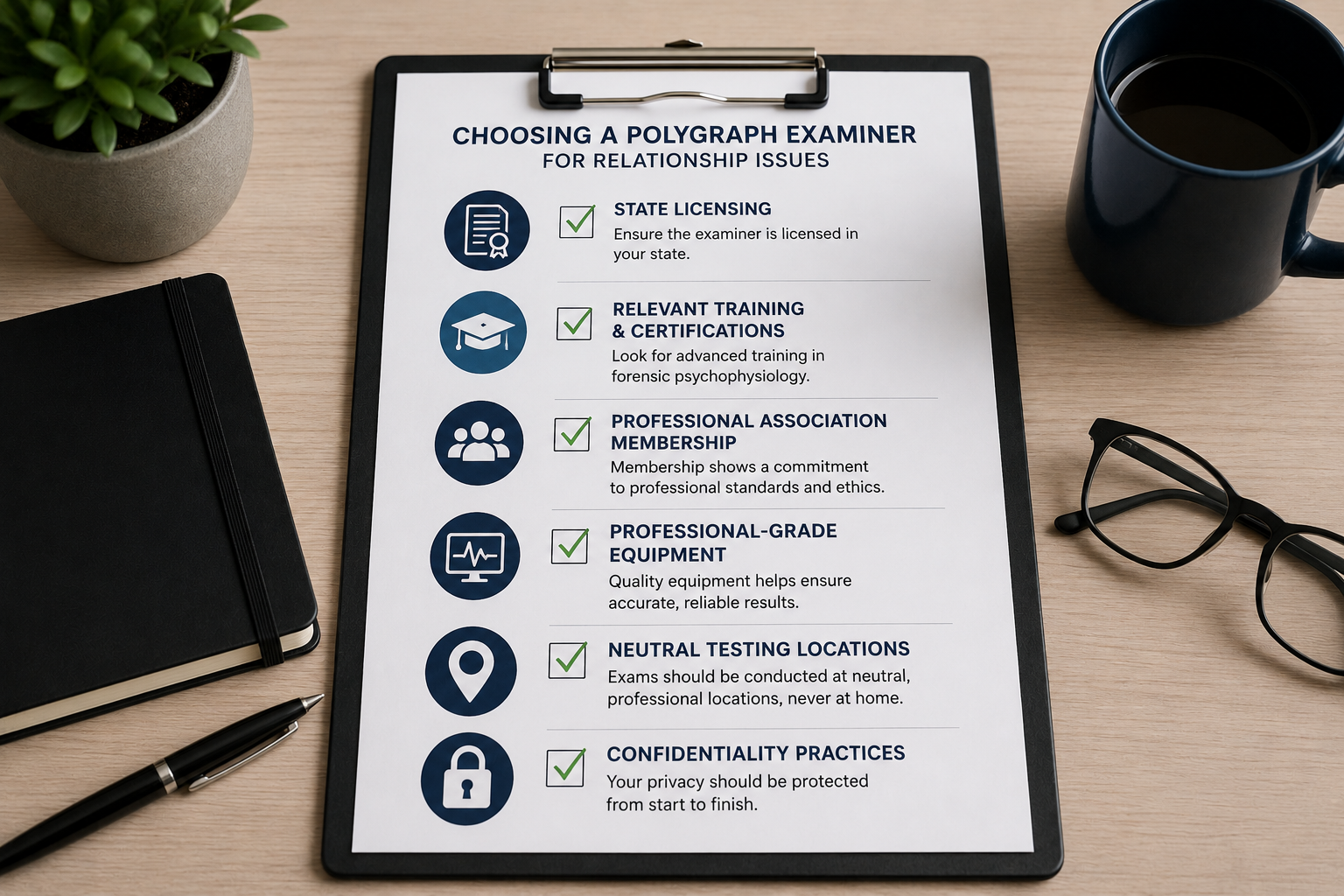
The checklist below breaks it down, one factor at a time:
- State licensing
- Relevant certifications and training
- Professional association membership
- Professional-grade equipment
- Neutral testing locations
- Confidentiality practices
State Licensing
Start with licensing, since a licensed examiner has met the requirements set by state authorities. I am licensed in North Carolina by the Private Protective Services Board and in South Carolina by the Law Enforcement Division. Because licensing is tied to specific states, confirm that an examiner can work where you are, whether that is Charlotte, Greensboro, or elsewhere in the region.
Relevant Certifications and Training
Strong examiner qualifications go beyond a license. I am a graduate of the Forensic Psychophysiologist Program at the International Academy of Polygraph in Fort Lauderdale, Florida, and I also hold a post-conviction certification for more specialized casework. Training like this teaches the science behind reliable questioning and analysis, and you can review my full background on the credentials page.
Professional Association Membership
Association involvement reflects a commitment to professional standards. I have served as a board member of the North Carolina Polygraph Association. Ties like these keep an examiner connected to current best practices, ethics, and accountability among peers in the field.
Professional-Grade Equipment
The tools an examiner uses affect the integrity of every exam. I use professional-grade, scientific equipment comparable to the systems trusted by federal agencies, and I travel with an actual polygraph chair fitted with motion sensors. Well-maintained, modern tools help produce clean, readable data and add an extra layer of rigor to the process.
Neutral Testing Locations
Where an exam happens matters as much as how. I conduct every exam at a neutral location, such as a private office or conference room, and never in a home. A neutral setting keeps the experience professional and removes the discomfort of being tested somewhere tied to the conflict itself.
Confidentiality Practices
Finally, ask how an examiner protects your privacy. Confidential testing is essential for something this sensitive, and privacy should never be an afterthought. I keep every case private from the first phone call through the sharing of results, so your information stays protected.
Questions to Ask Before You Book

Before you commit, a few direct questions can tell you a lot:
- Are you licensed in my state?
- What training and certifications do you hold?
- What equipment do you use?
- Where will the exam take place?
- How is my privacy protected?
Any reputable examiner will welcome these questions and answer them clearly.
The Advantage of a Mobile, Traveling Examiner
Not every examiner comes to you, and that difference can matter. A mobile examiner brings the equipment to a neutral site instead of requiring you to travel to a fixed office.
For anyone worried about privacy, this is a real advantage, since there is no public waiting room and no need to explain why you are there. It is also more convenient across a wide region. My multi-state credentials let me travel to clients throughout the area, from Spartanburg to smaller towns nearby, rather than tying testing to one city.
Confirming Coverage in Your Area
Because service areas vary, confirming coverage early is part of choosing an examiner you can trust for a relationship matter. The Polygraph Examiner serves North Carolina, South Carolina, and eastern Georgia.
That range reaches from Raleigh in the east to Augusta near the Georgia border. If your city is not listed on the site, it is still worth asking, since I travel widely across all three states.
Frequently Asked Questions
How do I know an examiner is qualified?
Check for a current state license, formal training in forensic psychophysiology, and membership in a recognized professional association.
Does it matter if the examiner travels to me?
It can. A traveling examiner offers more privacy and convenience, and lets you choose a neutral location that works for you.
A Free Consultation Is the Best Place to Start
Have questions about coverage in your area or my credentials? A free phone consultation is the best place to start. There is no pressure, just clear answers, because deciding which polygraph examiner to trust with a relationship issue often begins with a simple conversation.
 The Polygraph Examiner provides professional polygraph and lie detection tests for infidelity, cheating, or relationship struggles, as well as business theft, criminal cases, pre-employment, sexual assault accusations, sex offender cases, and sports integrity. Call our offices today for a FREE phone consultation at 800-497-9305.